
Retail inflation inched up to 4.48 per cent in October due to an uptick in food prices, government data showed on Friday. The Consumer Price Index (CPI) based inflation was at 4.35 per cent in September and 7.61 per cent in October 2020.

The TIME 100 AI list is an interesting assortment of titans. Indians make up about 20 per cent of the coveted list, which is pretty commendable, notes Sandeep Goyal.
Most members of the monetary policy committee (MPC) argued for front-loading interest rate hikes in view of rapidly rising inflation during the off-cycle monetary policy review earlier this month - the minutes of the meeting published on Wednesday showed. In early May, the rate setting committee met unscheduled and unanimously decided to hike the repo rate by 40 bps. This was the first repo rate hike in four years, and an inter-meeting hike in more than a decade.

Though fiscal deficit is a concern, the country needed spending to boost the economy hit by financial crisis, she said. Going by the bank's research, Kidwai said India is likely to grow at 8 per cent in next fiscal 2010-11.

'Some of the astounding proposals, if translated into statutory provisions, would be suicidal.' 'This would not be a wonder cure for increasing insurance penetration and only result in mushrooming growth of players like paan kiosks with deleterious consequences.'

India's economic growth will be above 6 per cent in the current fiscal as the country has managed to strengthen its macroeconomic stability and performance even in a period of large global shocks, RBI Monetary Policy Committee (MPC) Member Ashima Goyal said on Monday. Goyal further said that a global slowdown reducing India's export growth, geopolitics fueling oil and food prices, and erratic weather are some of the continuing risks that the country faces. "India has managed to strengthen its macroeconomic stability and performance even in a period of large global shocks.

Rajan also said it's a problem of collective action and not a problem of industrial nations or emerging markets

The government on Friday appointed Suman K Bery as the vice chairman of Niti Aayog, following the sudden resignation of Rajiv Kumar.

In the mid-quarter review on December 18, the Reserve Bank left key policy rates unchanged but said it will hike interest rates if inflation does not subside.

India's economic growth is estimated to have slowed down to 11-year low of 5 per cent during the current financial year ending March 2020.

High lending rates triggered by Reserve Bank's tight monetary policy have tranquilized the country's property market, but demand will surge once rates dip, real estate firm DLF Ltd's chairman K P Singh said on Tuesday.

People are availing far more of certain kinds of unsecured loans than was the case before the pandemic. Bank lending for buying consumer durables and funding of credit cards and other personal loans have risen by Rs 6.9 trillion between August 2019 and August 2023, shows a Business Standard analysis of data from the Reserve Bank of India (RBI). These loans are typically unsecured, which means they are provided without collateral.

The former RBI deputy governor talked about the prospects of an economic revival, reforms in IMF, etc.

After Raghuram Rajan leaves, the world for the succeeding RBI governors will be distinctly different.

The S&P BSE Midcap and the S&P BSE Smallcap indices have managed to stay afloat in a volatile January that saw the frontline indices hit their respective 52-week high levels and then slip. While the S&P BSE Sensex has lost over 2 per cent thus far in January, the S&P BSE Midcap and the S&P BSE Smallcap indices have gained nearly 2.5 per cent and 4 per cent, respectively during this period.

With credit demand picking up and liquidity crunch yet to ease, bankers are expecting a cut in key policy ratio - Cash Reserve Ratio (CRR) - by one per cent in the mid-term monetary policy review by RBI, a top bank official said.

Hikes benchmark lending rate by 35 basis points to 6.25 per cent Cuts growth projection for this fiscal to 6.8 per cent from 7 per cent estimated in September Inflation to come down below 6 per cent in March quarter, to average 6.7 per cent this fiscal

Retail inflation fell to a 15-month low of 5.66 per cent in March, mainly due to a decline in food prices, government data showed on Wednesday. The inflation figure in March is within the RBI's comfort zone as it is below 6 per cent. The retail inflation based on Consumer Price Index (CPI) was 6.44 per cent in February 2023 and 6.95 per cent in the year-ago period.
Investors need to gear up for a possible rise in interest rates (at least in the short-term) and consequently investment decisions have to keep this aspect in mind.
The Organisation for Economic Co-operation and Development (OECD) has in its latest report applauded the Indian economy's resilience and has projected a growth rate of 7 per cent in 2010 and 7.5 per cent for 2011. However, it says that India's central bank must tighten its monetary policy fairly soon to contain the rising inflation. "Given the speed at which inflation has bounced back, monetary policy will need to be tightened fairly soon," the Paris-based OECD.

Finance Minister Nirmala Sitharaman is scheduled to address the post-budget meeting of the RBI's central board on Monday and highlight key points of the Union Budget 2022-23, including the fiscal consolidation roadmap and high capex plan. It has been a custom that the finance minister addresses the RBI board, consisting of RBI Governor and existing four deputy governors, after the Budget. The meeting has been scheduled for February 14 where she would be addressing the board members and talk about announcements made in the Budget to perk up growth hit by three waves of COVID-19, sources said.

Indian economy is expected to clock an average growth rate of 6.7 per cent till 2026-27 fiscal driven by domestic consumption, S&P Global Ratings senior Economist (Asia Pacific) Vishrut Rana said on Wednesday. He said the economic growth in the current fiscal is expected to come in around 6 per cent, lower than 7.2 per cent clocked in 2022-23. "We are seeing some headwinds from the trade side which is affecting activity and that is one of the factors that is affecting growth this year," Rana said at a webinar.

The Prime Minister's Economic Advisory Council member G Govinda Rao on Thursday said the Reserve Bank can raise the key rates ahead of its April 20 annual monetary policy to tame the high headline inflation.

India's manufacturing sector activity hit the highest level in eight months in July, driven by a significant rise in business orders, a monthly survey said on Monday. The seasonally adjusted S&P Global India Manufacturing Purchasing Managers' Index rose from 53.9 in June to 56.4 in July, reflecting the strongest improvement in the health of the sector in eight months. The July PMI data pointed to an improvement in overall operating conditions for the 13th straight month.

India's political infighting is denting business confidence.
The Reserve Bank of India on Friday decided to keep the benchmark interest rate unchanged at 4 per cent but maintained an accommodative stance as the economy is yet to recover from the impact of the second Covid wave.

After navigating the turbulent pandemic waves, the recovering Indian economy is now sailing through unchartered waters of rising coronavirus cases, spiralling commodity prices and spiking inflation though the lighthouse of sustainable growth remains visible. As 2022 begins, a raft of developments, ranging from Budgetary announcements to continuation of stimulus measures to monetary policy, will set the tone for the domestic economy, which is projected to grow more than 9 per cent in the current fiscal ending March 2022. The country's continuing massive vaccination drive and 'precaution' doses starting for select categories of people this month will provide a firewall against any steep spike in coronavirus cases amid the emergence of the Omicron variant.

Fintech companies believe that the impact of Reserve Bank of India's order last week on unsecured loans will be visible in six to 12 months and prompt them to diversify and strengthen their secured portfolio. Fintechs which source funds through banks or non-banking finance companies (NBFCs) are looking at quickly building their secured portfolio options to at least 40 per cent of their total portfolio. "Over the medium to long term, as part of our product strategy, we are evaluating secured products which can be enabled over a digital platform" said Yogi Sadana, the founder of Zype, a lending-focussed fintech.

The US Federal Reserve's interest rate decision, global market trends and trading activity of foreign investors are the major factors that would dictate terms in the equity markets in a holiday-shortened week ahead, analysts said. Equity markets will remain closed on Tuesday on account of Ganesh Chaturthi. From the global front, interest rate decisions from the Bank of England and Bank of Japan would also influence market trends.

Acharya was one of the youngest deputy governors in the central bank's history and was in charge of the critical monetary policy department which also made him a part of the rate-setting panel.

Hinting at some tightening of the monetary policy on Friday, the Reserve Bank on Thursday said inflation is a major challenge and would address it without hurting the growth.

Sectoral performance was mixed with media and PSU banking stocks attracting buyer interest and healthcare, FMCG and metal stocks bearing the brunt of the bears

Raghuram Rajan said a six-member monetary policy committee will decide on interest rates.

Declining vegetable prices brought down the retail inflation to a 15-month low of 4.59 per cent in December and within the comfort zone of the Reserve Bank, government data showed on Tuesday. It is for the first time during the current fiscal that the Consumer Price Index (CPI) based inflation print is below 6 per cent or in the RBI's target range of 2 to 6 per cent. The central bank factors in the CPI-based inflation while arriving at its monetary policy. The inflation in December 2020 came down from 6.93 per cent in November, mainly on account of 10.41 per cent decline in vegetable prices over the year-ago period.
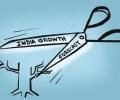
Moody's on Friday slashed India's GDP growth projections for 2022 to 7 per cent from 7.7 per cent earlier as the global slowdown and rising domestic interest rates will dampen economic momentum. This is the second time that Moody's Investors Service has cut India's growth estimates. In September, it had cut projections for the current year to 7.7 per cent from 8.8 per cent estimated in May. "For India, the 2022 real GDP growth projections have been lowered to 7 per cent from 7.7 per cent.

The World Bank on Tuesday raised the growth forecast for the Indian economy to 7 per cent for the current fiscal year on the back of recovery in agri sector and rural demand. World Bank had in June projected India to grow at 6.6 per cent for FY24. According to the World Bank Report released on Tuesday, India's growth continues to be strong despite a challenging global environment.
Fitch Ratings on Tuesday retained India's economic growth forecast at 7 per cent for the current fiscal, but cut projections for the next two financial years saying the country is not impervious to global developments. In its December edition of the Global Economic Outlook, Fitch projected India's GDP to grow at 7 per cent in the current fiscal, at a slower rate of 6.2 per cent in 2023-24 and at 6.9 per cent in 2024-25. In September, Fitch projected 7 per cent growth for the current fiscal, followed by 6.7 per cent in 2023-24 and 7.1 per cent growth in 2024-25.
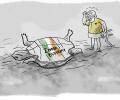
The International Monetary Fund (IMF) on Tuesday slashed India's growth forecast for 2022-23 (FY23) by 80 basis points to 7.4 per cent, citing less favourable external conditions and rapid policy tightening by the central bank. In its update to the April World Economic Outlook, the IMF said that though a global recession in 2022 was ruled out with a growth estimate of 3.2 per cent, the balance of risks was squarely to the downside, driven by a wide range of factors that could adversely affect the global economic performance. "The risk of recession is particularly prominent in 2023, when in several economies growth is expected to bottom out, household savings accumulated during the pandemic will have declined, and even small shocks could cause economies to stall.
The Reserve Bank on Friday retained the real GDP growth projection at 9.5 per cent for 2021-22 as domestic economic activity has started normalising with the ebbing of the second wave of the virus and the phased reopening of the economy. In the June monetary policy, the RBI had lowered the growth projection for 2021-22 to 9.5 per cent from 10.5 per cent estimated earlier. Unveiling the bi-monthly monetary policy, RBI Governor Shaktikanta Dad said high-frequency indicators suggest that consumption (both private and government); investment; and external demand are all on the path of regaining traction.

The Indian rupee may remain under depreciation pressure on account of plateauing of exports and subsequent widening of the current account deficit, said the Economic Survey 2022-23 tabled in Parliament on Tuesday. It said the "risks to the current account balance stem from multiple sources". The country's current account deficit (CAD) widened to 4.4 per cent of the GDP in the quarter ended September from 2.2 per cent in April-June due to higher trade gap, as per latest data of the Reserve Bank of India.
